
Wearable battery life: what really determines how long a device runs
Why the datasheet-power-divided-by-capacity math is always wrong, and the three real drains — radio, sensors, and display — that decide runtime.
Why wearable battery life estimates are so often wrong
The most common approach is to take the battery capacity and divide it by the power figure printed in the chip's datasheet. It sounds reasonable, and it almost always produces a number two to three times better than reality.
It's a bit like estimating how far a tank of fuel will take you based only on highway cruising consumption. In real driving there are traffic lights, congestion, cold starts, and air conditioning. A wearable is the same: beyond the main chip, a whole set of components quietly draws power around the clock. Battery life is not a property of a component — it is the result of how the product is used.
The simplest way to think about wearable battery life
Picture the battery as a water tank, and every moment the device does something as one scoop taken out of it. Three things decide how fast the tank empties:
- How large the tank is — the battery capacity.
- Whether the tank has a slow leak — the power the device consumes even while sitting idle.
- How many scoops are taken each day — how often the device wakes up and does work.
Here's what surprises most people: the third factor usually matters far more than the first. Doubling the battery capacity gets you twice the runtime. Cutting how often the device sends data can get you ten times the runtime.
The three biggest battery drains in a wearable
Sending data. Every time the device connects and transmits to a phone, it spends meaningful energy. This is almost always the largest single cost. A device that sends data every second will drain its battery many times faster than one that collects data and sends it once an hour.
Measuring continuously. Heart rate, motion, and temperature sensors all consume power while they're switched on. Sampling fifty times a second is a completely different proposition from sampling once a minute, even when what the user sees on screen looks identical.
The display and the vibration motor. A lit screen is the single hungriest component in any given moment. That's why smartwatches with displays last a few days, while screenless bands last a month.
There's also the slow leak: the power the device consumes twenty-four hours a day, even sitting unopened in a box on a shelf. It's small, but because it never stops, it can account for most of the total energy budget in a product designed to run for months.
Why two similar wearables can differ by weeks
Compare two products built on the same chip with the same battery size:
- An activity band that collects data and syncs to the phone once an hour.
- A shoulder-worn sports device that measures motion at high speed and streams data continuously.
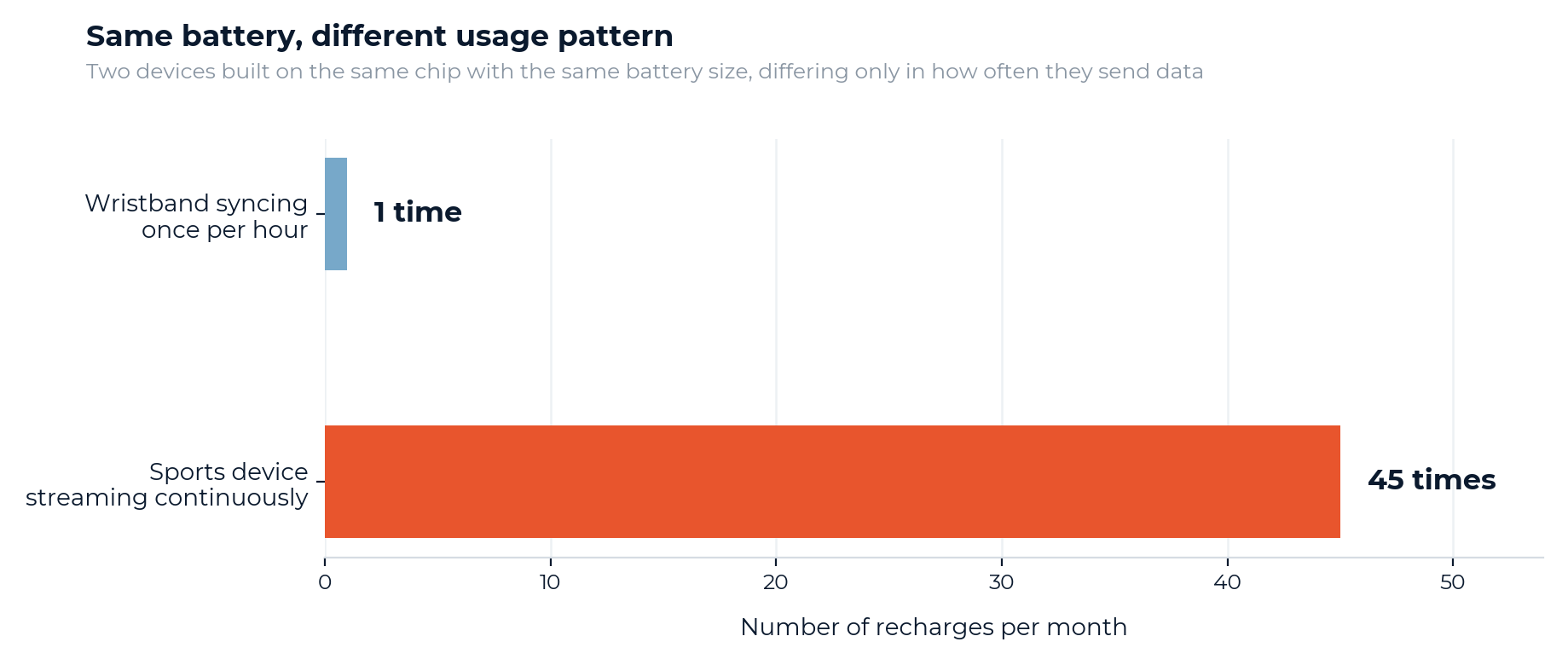 Figure 1. Recharges per month for two wearable devices built on identical hardware.
The first runs for over a month on a single charge. The second runs for roughly half a day.
Both are good designs. They simply serve different purposes. The sports device is used in training sessions of one to two hours, so half a day is more than enough. The activity band is meant to be worn continuously, so asking the user to charge it daily is a failure. This is why the battery question has to be answered alongside the question of how the product will be used, not after the design is finished.
Every feature added to a wearable device carries a battery cost.
Label capacity versus what your wearable actually gets
A battery marked at 100 units of capacity does not give the device a full 100 units to work with. There are two reasons.
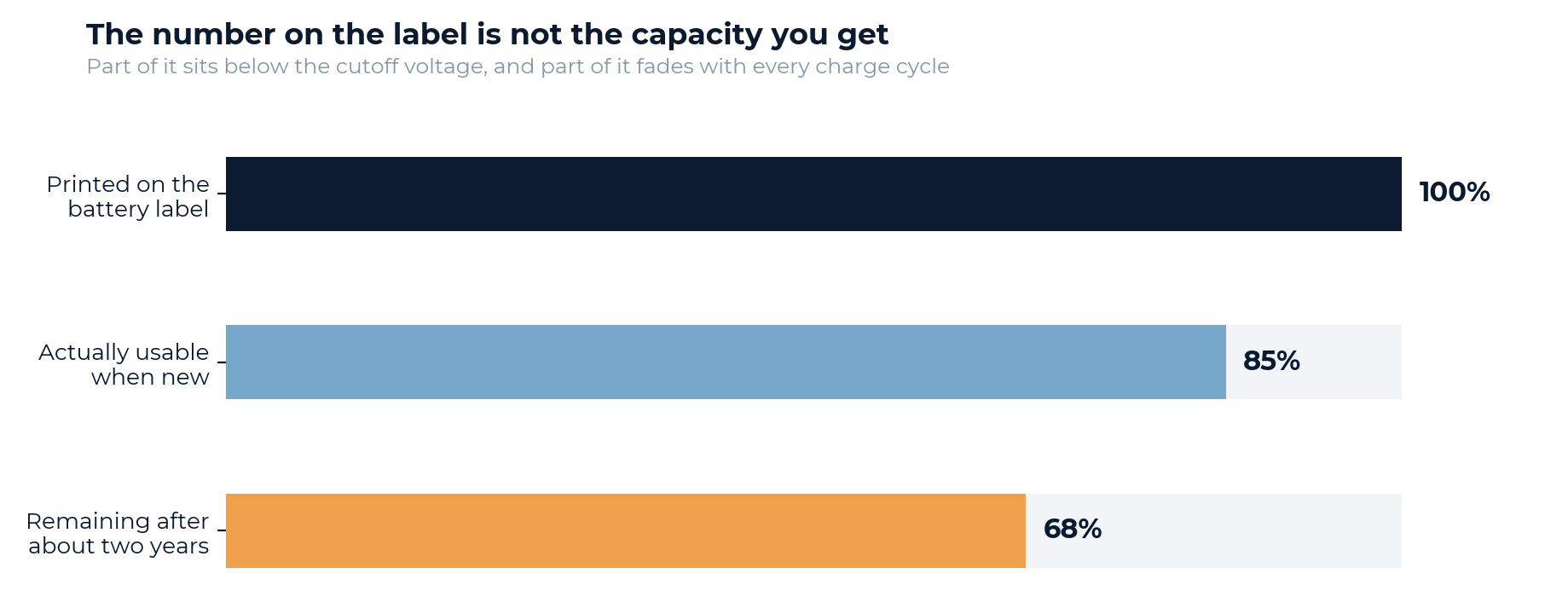 Figure 2. The gap between rated and usable battery capacity in a wearable device.
First, the device stops working before the battery is fully empty, so the capacity at the bottom is unreachable. Second, batteries degrade with time and charge cycles, retaining roughly eighty percent of their original capacity after about two years.
So if a product is marketed as lasting thirty days, that figure should still hold in year two, not just for the first unit off the line.
A bigger battery is not always the answer
When the battery falls short, the instinctive fix is to fit a larger one. But on a device worn against the body, every millimeter has a price.
A bigger battery means a thicker, heavier product that's less comfortable to wear, and one the user abandons in a drawer after two weeks. It also means a larger enclosure, more expensive tooling, harder waterproofing, and longer charging times.
In most cases the cheaper and more effective route is to change how the device behaves: batch data and send it in bursts instead of streaming, wake the sensors only when motion is detected, and keep the display off unless it's needed.
Four questions that estimate battery life early
If you're preparing to build a wearable product, answering these four questions gives enough basis for a reasonably accurate estimate:
- How many times a day does the device need to send data to the phone?
- Do the sensors need to measure continuously, or only when there is motion?
- Does the product have a display, and how many minutes a day will it be lit?
- How often can the user be asked to charge it and still be comfortable?
The last question matters most, because it comes from the user rather than from engineering. A medical device worn in a hospital can be charged daily without issue. A sleep-tracking ring cannot, because the moment it most needs to be worn is the moment the user is asleep.
Working with DevBriX on your wearable project
DevBriX Engineering is a product engineering studio based in Ho Chi Minh City, Vietnam. We take hardware products from concept through to production readiness.
What DevBriX can do for a wearable project
- Consulting and feasibility studies — whether the product can be built, what it takes, roughly what it costs, and how long it will run.
- Hardware design — circuit design, PCB layout, antenna, power and charging.
- Embedded firmware — the software inside the device, covering Bluetooth connectivity, power management, and over-the-air updates.
- Mechanical design — enclosure, straps, waterproofing, and injection mold preparation.
- Mobile applications — iOS and Android apps that pair with the device.
- Production support — functional test fixtures for the line, certification documentation, and working with your manufacturer.
Beyond wearables, DevBriX also builds custom automation machinery, PLC integration, robotics and AGV/AMR systems, precision machining, and production jigs.
How a wearable project with DevBriX runs
- Initial conversation — a 30 to 45 minute call to understand your idea and your goals. No charge.
- Technical proposal and quote — we send a written solution outline with phases, timelines, and cost for each part.
- Proof of concept — we build a working sample of the core functionality so you can see the product running before committing to the full investment.
- Phased development — each phase has a clear deliverable and sign-off point, so you can track progress against the plan.
- Handover — full design files and source code are delivered to you, with support through the transition into production.
What to prepare before getting in touch
You don't need technical drawings or specification documents. Describing these four things is enough to make the first conversation productive:
- What the product does and who will wear it.
- Which features are essential, and which are nice to have.
- Expected production volume in the first year.
- Approximate budget and target launch date.
If the last three are still unclear, that's fine. Most clients come to us while the idea is still a sketch, and the first conversation exists precisely to work those out.
Contact DevBriX
Ready to talk it through? Reach out through the DevBriX contact page or book a call directly — the engineering team will walk through your project with you.