
One-stop solution: taking a hardware product from PCB to production under one roof
Why running PCB, firmware, app, and industrial design through one in-house team — instead of coordinating separate vendors — keeps integration issues from surfacing late.
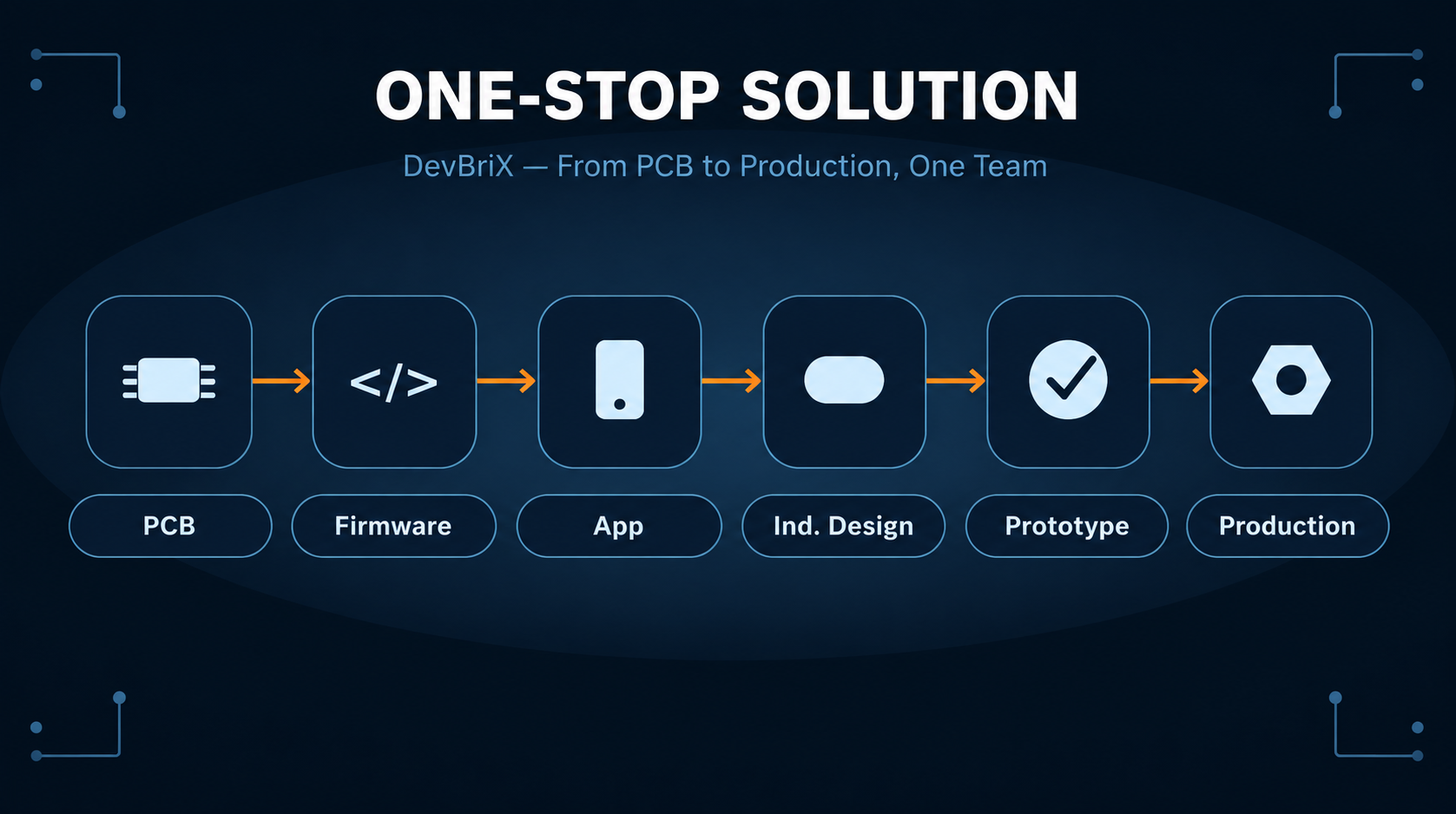
What is a one-stop solution?
A one-stop solution is a model where a single team handles the full journey of building a hardware product: PCB design, firmware, a companion app or software (when needed), industrial design, a first working prototype, and support into production — instead of stitching together separate vendors for each stage.
What matters is that these stages sit with the same in-house engineering team, who understand the product end to end, rather than a middleman coordinating separate specialists behind the scenes.
Why consider a one-stop solution?
Compared with running separate vendors for each stage, a one-stop solution addresses some of the most common friction points in building a new hardware product:
- Accountability when something fails — with multiple vendors, it's easy to point fingers at integration boundaries; with one team, a single party is accountable for the full system.
- Project timeline — a multi-vendor project depends on multiple schedules and handoffs; a one-stop project is coordinated internally, so stages can run in parallel.
- PCB – firmware – app alignment — separate vendors risk mismatches between hardware, firmware, and software; one team designs them together, so integration issues surface earlier.
- Hidden costs — a multi-vendor setup often needs an extra coordinator role; a one-stop quote bundles everything, which is easier to budget against.
- Support after production — with multiple vendors it's unclear who owns a fault spanning hardware, firmware, or app; one team already knows the full system.
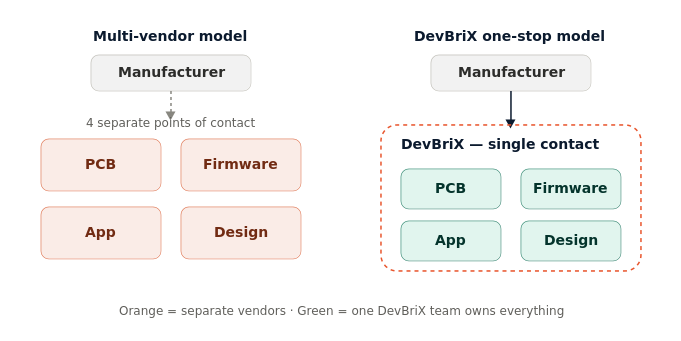 Multi-vendor coordination (left) versus DevBriX's one-stop model (right).
The DevBriX one-stop process: from PCB to production
At DevBriX, this happens as one continuous flow, with the same team carrying the product through every stage:
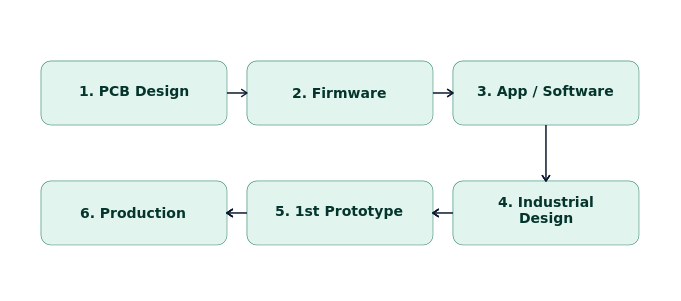 DevBriX's six-step one-stop solution process: from PCB to production.
- PCB Design — schematic and layout for the electronics at the core of the product.
- Firmware — the embedded software that runs on the device: drivers, connectivity, power management.
- App / Software Design — the companion mobile, web, or cloud app that pairs with the hardware.
- Industrial Design — the physical form and enclosure the electronics live inside.
- 1st Prototype — the first working unit that brings hardware, firmware, app, and enclosure together.
- Production — manufacturing support to take that prototype into volume.
Because one team carries all six stages, mismatches between the enclosure and the PCB, or between the app and the firmware, tend to surface while they're still cheap to fix, not after tooling is already cut.
DevBriX's one-stop track record
- Full capability in one team: DevBriX has 10+ years of experience, with hardware (PCB) engineers, firmware engineers, and software engineers working directly in-house — the setup behind the company's own positioning, "One team. One partner. One solution."
- That process has shipped real products: a line of wearables (smartwatches, smart rings, and sleep/fitness bands), a bedside sleep-aid device with a companion sleep-tracking app, and a smart house-number sign with OTA firmware updates and cloud-based device management.
- Broad platform coverage: the team works across common MCU platforms (STM32, NXP, TI, Renesas, Microchip, among others), wireless connectivity (BLE, Wi-Fi, LoRaWAN, cellular), and cloud integration (AWS IoT, Azure).
- Track record: DevBriX holds Top Rated Plus status on Upwork with a 100% job success score, and has delivered projects across 12+ global markets.
See if it fits your project. If you're weighing a one-stop approach against separate vendors, the fastest way to find out is a short conversation with DevBriX's engineering team — get in touch to explore the possibilities.
Where a one-stop solution fits best
A one-stop solution fits best for products that need hardware, firmware, and software working closely together, for example:
- Wearables & health tech — watches, rings, and sleep or fitness trackers need a compact PCB, low-power firmware, and an app that stays in sync.
- Smart home & IoT — connected devices need stable firmware, reliable wireless connectivity, and an app that doesn't feel bolted on.
- Industrial IoT & monitoring — sensors and remote monitoring devices need long-term reliability and OTA firmware updates.
- Connected consumer devices — products where the enclosure, the app, and the out-of-box experience all need to feel like one product, from the first prototype onward.
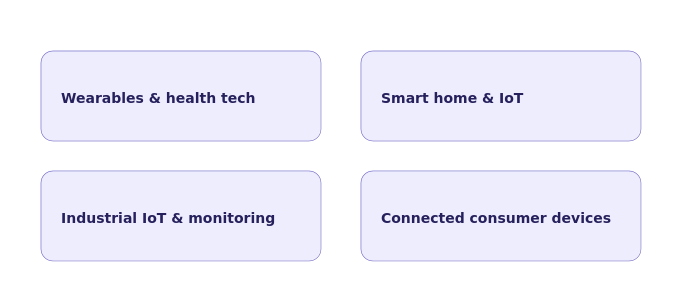 Product categories where a one-stop solution tends to add the most value.
Frequently asked questions
1. Is a one-stop solution more expensive than hiring separate vendors?
Not necessarily. Upfront quotes can be similar, but the total cost of a multi-vendor project often includes coordination overhead and the cost of fixing integration issues discovered late — costs that are harder to see upfront but tend to show up later.
2. How do I know a one-stop provider can really do PCB, firmware, and app work — not just claim to?
Ask directly who designs the PCB, who writes the firmware, and who builds the app — in-house engineers or subcontractors. A genuine one-stop solution provider will have someone for each discipline working inside the same team.
3. Does a one-stop solution make sense if my product is still just an idea?
Yes — that's often when it helps most, since early-stage teams rarely have the in-house capacity to coordinate PCB, firmware, and app work separately.
4. What kind of support is available after a one-stop product goes into production?
Because the same team holds the full design from PCB to app, bug fixes, new revisions, or scaling up production tend to move faster than handing the project back to a third party.
5. How long does a one-stop project take, from PCB to first prototype?
Timelines depend on product complexity, so DevBriX scopes a project-specific timeline after understanding the requirements rather than quoting a general number.
Conclusion: is a one-stop solution right for you?
A hardware product moves through several stages — PCB, firmware, app, industrial design, prototype, production — and each handoff between them is a place where things can go wrong: an app that doesn't match the firmware, an enclosure that doesn't fit the PCB, a prototype that behaves differently than the concept. A one-stop solution won't remove every risk, but it does mean one team is accountable for the whole path, so problems tend to surface earlier.
Ready to talk it through? Reach out through the DevBriX contact page or book a call directly — the engineering team will walk through your project with you.