
Can wearables actually be trusted with our health?
PPG sensors, skin-tone accuracy gaps, and the FDA's general-wellness line — what the research actually shows about how far you can trust a wearable's health readings.
What "trust" really means for a wearable
There are two separate questions people tend to blur together:
- Is the sensor reading accurate? Does the number on the screen match what a clinical instrument would measure?
- Is the device allowed to make health claims? Has it been validated and cleared to say what it's saying, or is it operating under a much lighter "general wellness" standard?
A device can be reasonably accurate but not medically validated, or medically cleared for one specific feature while its other metrics remain general-wellness estimates. Treating a wearable as "trustworthy" or "not trustworthy" as a single verdict misses this distinction — and it's exactly where most of the confusion, and most of the marketing, lives.
Where wearable sensor data actually breaks down
Most wrist-worn health metrics — heart rate, heart rate variability, SpO2 — come from photoplethysmography (PPG): a sensor shines light into the skin and measures how the reflected light changes as blood pulses through capillaries. It's a clever, low-cost way to estimate cardiovascular signals without drawing blood or attaching electrodes. It's also an indirect measurement with several well-documented failure points.
Motion is the biggest one. PPG signals are sensitive to movement, and research has shown that even the contact pressure between the sensor and skin measurably affects accuracy — one study found an optimal contact pressure point (around 54 mmHg), with accuracy degrading as pressure moved away from it in either direction (PMC7570982). That's a big part of why heart rate readings tend to be fairly reliable at rest and noticeably less reliable during exercise or irregular activity.
Skin tone is another documented factor, though the picture is more nuanced than "wearables fail on dark skin." A 2024 systematic review and meta-analysis of pulse oximetry accuracy — pooling 23 studies and nearly 60,000 participants — found that SpO2 accuracy error exceeded the FDA and ISO's 3% regulatory threshold across light, medium, and dark skin pigmentation groups alike (J Med Internet Res 2024;26:e62769). The size and direction of the bias did vary by group, which is a real problem for anyone relying on precise readings, but it isn't a problem limited to one population.
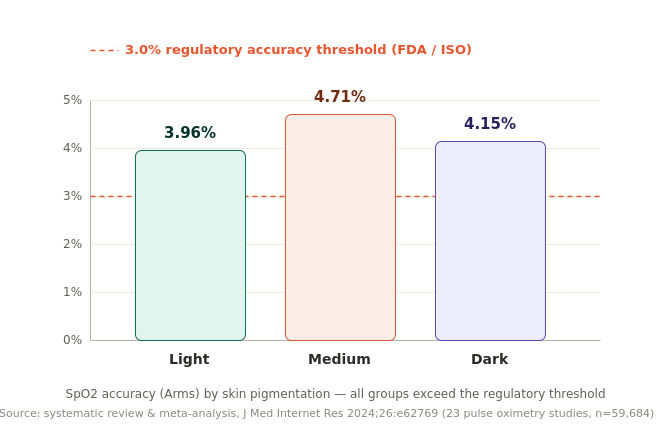 SpO2 accuracy error by skin pigmentation, against the 3% FDA/ISO accuracy threshold. Source: J Med Internet Res 2024;26:e62769.
Sleep tracking has its own gap. Wearables estimate sleep stages from movement and heart rate patterns, not brain activity, and studies comparing this against polysomnography (the clinical sleep-lab standard using EEG) have found only moderate agreement — roughly 60-70% in one analysis — with a consistent pattern of underestimating REM sleep and overestimating deep sleep (Depner et al., 2020). Your wearable's sleep score is a reasonable trend indicator; it isn't a sleep study.
General wellness device, or medical device?
Separately from sensor accuracy, there's a regulatory line that determines what a wearable is legally allowed to say about your health. The FDA's General Wellness Policy exempts low-risk products from medical device regulation as long as they stick to healthy-lifestyle claims and don't reference diagnosing, treating, or monitoring a specific disease or condition.
- A general wellness device supports a healthy lifestyle and doesn't reference a specific disease — for example, "track your sleep quality and daily activity trends." It's generally exempt from FDA oversight, under enforcement discretion.
- A medical device diagnoses, treats, mitigates, or monitors a specific condition — for example, "detect atrial fibrillation," or clinical blood pressure monitoring. It requires FDA clearance or approval before marketing.
FDA revised this policy on January 6, 2026, expanding the range of biomarkers (like sleep hours, sleep quality, and pulse rate) a general wellness device can report without triggering medical device regulation (FDA, General Wellness: Policy for Low Risk Devices, Jan 6, 2026). But the agency has also been tightening enforcement in specific categories: in July 2025 it sent a warning letter to a wearable manufacturer over blood pressure insights, and in September 2025 followed up with a safety communication stating that blood pressure measuring devices require formal FDA marketing authorization — they don't qualify as general wellness products, no matter how the claims are worded (Troutman Pepper Locke, "FDA's 2026 Guidance on General Wellness Devices"). Blood glucose wearables using microneedle technology got a similar carve-out, even with purely wellness-framed claims (Covington & Burling, "FDA Issues Revised Guidance on General Wellness Products," Jan 2026).
The takeaway: the regulatory status of a wearable says more about what it's allowed to claim than about how good its underlying sensor is. A general wellness device isn't automatically less accurate than a cleared one — it just hasn't gone through, and isn't required to go through, the same validation process.
What actually makes a wearable more trustworthy
 Real-world wear — a coffee mug in one hand, an arm resting on a table — is exactly the kind of everyday condition lab-only accuracy testing tends to miss.
Firmware and algorithms matter as much as the sensor part number. Device-comparison studies have found meaningful accuracy differences between wearables using similar PPG hardware, attributed to differences in sampling rates and proprietary signal-cleaning algorithms — the raw sensor is only half the story (PMC12912460).
Real-world validation matters more than lab specs. Accuracy studies consistently show devices perform better in steady, controlled conditions than during irregular real-world activity, so validation done only in a lab tends to overstate everyday accuracy (PMC12912460; PMC7570982).
Device-to-device variance is real, even among major brands. In one comparison of ten commercial wearables against a chest-strap reference, some devices maintained strong agreement across conditions while others showed wider error margins, particularly during non-steady activity (PMC12912460).
Honest scoping of claims shapes how rigorously a device needs to be validated. A wearable built and marketed as a general wellness product carries different validation expectations than one claiming to detect a specific health condition — and blurring that line is exactly what's drawing FDA scrutiny in 2025 and 2026.
Building a wearable? What this means for your product
If you're developing a wearable rather than just wearing one, these findings translate into concrete product decisions, not just interesting research:
- Decide general-wellness or medical-grade positioning early. It changes sensor selection, the rigor of firmware validation, and which claims your app copy and marketing are legally allowed to make.
- Budget real engineering time for signal processing, not just sensor sourcing. The accuracy gap between wearables using similar hardware comes down largely to firmware-level filtering and calibration.
- Validate across real users, not just lab conditions and a narrow demographic. Skin tone, motion, and activity type all measurably affect PPG accuracy, and the regulatory and reputational risk of skipping this has only grown.
This is squarely the kind of work DevBriX does for wearable clients: hardware, firmware, and companion app development handled by the same in-house engineering team, rather than split across vendors who never have to reconcile a sensor spec sheet with what the firmware actually outputs in someone's hand.
Building a wearable and want a second opinion on your sensor and firmware approach? Contact our engineering team to discuss your project.
Frequently asked questions
1. Are wearable heart rate readings accurate?
For resting heart rate under steady conditions, generally yes — one study found a mean absolute error under 1 beat per minute against an ECG-based reference, particularly during sleep (PMC11548599). Accuracy drops noticeably during movement, irregular activity, or when the sensor isn't making firm skin contact, since PPG is sensitive to motion and contact pressure (PMC7570982).
2. Can my wearable detect low blood oxygen or other health conditions?
Consumer wearables can flag trends worth paying attention to, but they aren't validated to the same standard as clinical pulse oximeters, and most are explicitly positioned as general wellness tools rather than diagnostic devices. If you have symptoms or a diagnosed condition that depends on accurate SpO2 readings, a clinical-grade device is the right tool, not a wrist wearable.
3. Why do wearables perform worse on some skin tones?
Pulse oximetry works by shining light through skin and measuring how much is absorbed, and melanin absorbs some of that light too, which can distort the reading. A 2024 meta-analysis of 23 studies found that accuracy issues aren't limited to darker skin tones alone — light, medium, and dark pigmentation groups all exceeded the regulatory accuracy threshold — but the size and direction of the error did vary by skin tone (J Med Internet Res 2024;26:e62769).
4. Is my wearable's sleep data actually accurate?
It's directionally useful but not clinically precise. Wearable sleep staging (light, deep, REM) is estimated from movement and heart rate patterns, not brain activity, and studies comparing it to polysomnography have found only moderate agreement (roughly 60-70%), with a tendency to underestimate REM sleep and overestimate deep sleep (Depner et al., 2020).
5. What's the difference between a "general wellness" wearable and an FDA-cleared one?
It comes down to claims and validation, not necessarily the hardware. A general wellness device can measure similar signals to a cleared medical device, but it can't claim to diagnose or monitor a specific condition, and it hasn't gone through FDA's clearance process. FDA has been tightening this line recently — blood pressure wearables are a clear example of a category that now needs formal clearance rather than a wellness label.
Contact DevBriX
Ready to talk it through? Reach out through the DevBriX contact page or book a call directly — the engineering team will walk through your project with you.