
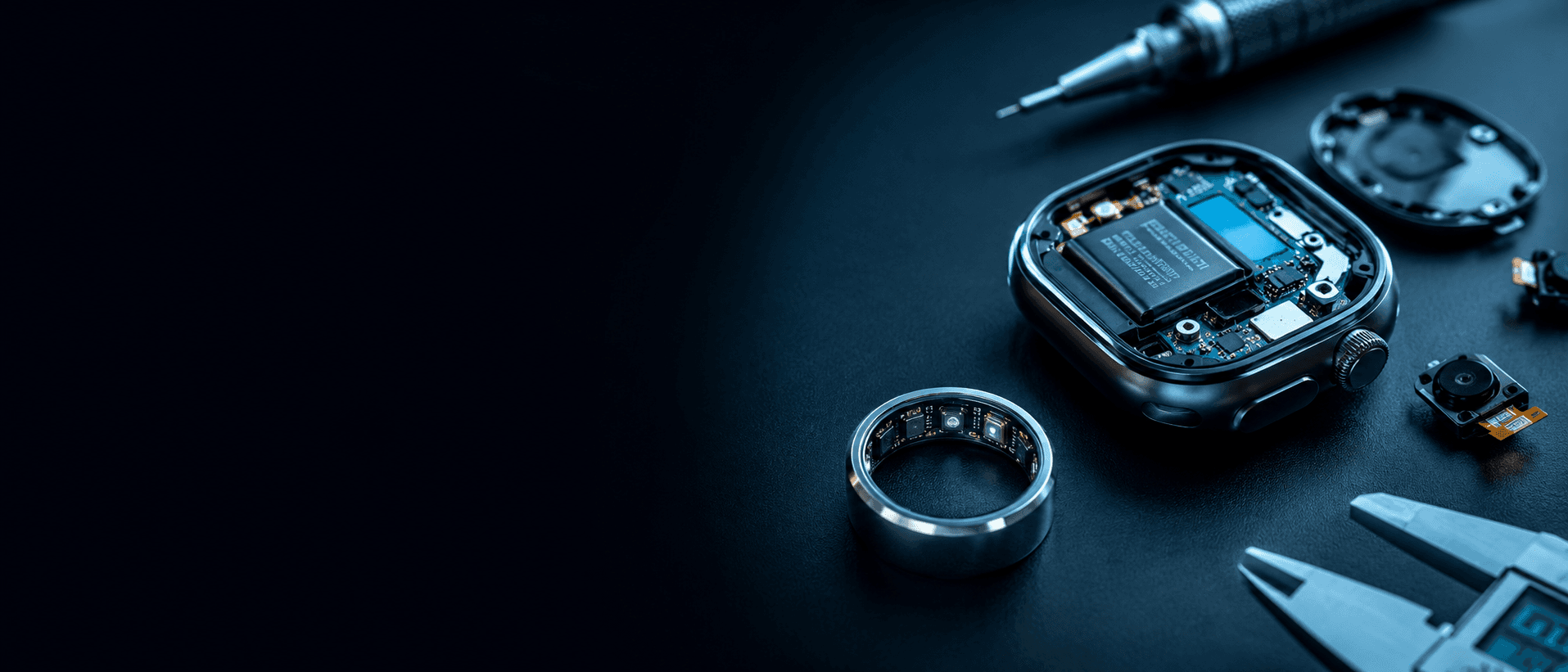
Bring your wearable idea to life
From concept to finished prototype. DevBriX owns every stage — hardware design, firmware, BLE connectivity, and industrial design — turning your idea into a complete, working product.
CAPABILITIES
What we do
Industrial Design
Starting from anthropometric analysis, 3D surfacing in Rhino and SolidWorks. Housing and CMF optimized for DFM to keep assembly simple.
PCB Design
Multi-layer PCB built around a power-efficient Cortex-M MCU. Sensors, IMU, PMIC, and radio share one board, with analog and RF domains separated to cut cross-noise.
Low Power Firmware
Firmware defaults to deep-sleep, waking only when needed. BLE parameters and sensor duty-cycle are tuned per application, with real current draw measured before every build is signed off.
Connectivity and Companion App
BLE pairing and high-speed data sync. Native companion apps for iOS and Android, with OTA firmware updates built in.
Charging and Battery Systems
Battery cell chosen to fit the design's exact form factor. Power stage includes protection circuitry and a fuel gauge for accurate capacity readout, supporting both magnetic pogo-pin and wireless charging.
PROCESS
From Idea to Prototype
Brief intake & feasibility review
We analyze the client's constraints: form factor, battery capacity, target cost, and timeline.
Architecture & component selection
Lock down the technical backbone — MCU, sensors, radio, and power stage — while sketching component placement to fit the intended housing form.
Hardware, firmware, and housing in parallel
Hardware lays out the board, firmware writes the drivers, industrial design builds the 3D model — all three tracks run continuously in sync so the housing and board never drift apart.
Integration & testing
Board, battery, and housing come together as one unit for functional testing, real current-draw measurement, and wear testing. Any mismatch is corrected in the 3D files or the board right away.
Prototype handoff
A finished prototype is delivered for hands-on evaluation. For projects heading to production, DevBriX supports DFM optimization and quality oversight on the first production runs.
TECHNICAL DEEP DIVE
Power and Firmware
Wearable battery life isn't about a bigger cell — it's about how intelligently the device wakes up and sends data.
DevBriX firmware defaults to a deep-sleep state. Built on the Nordic nRF52832, the system idles below 2µA, waking only when a sensor flags an event or a BLE transmission window comes due.
Each time it wakes, the device batches sampling, processing, and transmission into one short burst, then returns to sleep. On one wearable project, this approach cut power consumption by roughly 45% — taking a 150mAh cell from a few dozen hours to 14 days on standby.
< 0µA
Sleep-state current draw
0%
Power consumption reduction
0mAh
Test battery capacity
0 days
Maximum standby time
HOUSING DESIGN
Industrial Design
A wearable's housing isn't just its outer layer — it defines comfort and manufacturability.
Anthropometric research
Analyzing data by wear location — wrist, finger, ear — to reach an optimal fit.
Concept development
Aesthetic direction is sketched alongside the hardware layout, so the exterior never fights the engineering logic underneath.
Detailed design & 3D modeling
Rhino and SolidWorks model every joint, latch, and wall thickness so the product stays watertight and structurally sound.
Prototyping & real-world evaluation
SLA or FDM 3D-printed prototypes are worn and tested directly to fine-tune comfort before committing to tooling.
Material and finish selection
Defining aluminum, titanium, PC, or ABS materials, along with scratch-resistant finishes and color options aligned to brand positioning.
Production handoff
Drawings are optimized for the factory floor, with close oversight of the first production runs to verify color, fit, and mechanical durability.
FEATURED PROJECTS
Featured Projects
Loupe
Ultra-compact health wearable
DevBriX handled hardware, an optical biosensor, and power-efficient firmware on a BLE-based platform. The biggest challenge was fitting the sensor, radio, and power cluster into an 18x18mm footprint while keeping optical signal noise under 2%. Concept to working prototype in just 6 weeks.
Aura Ring
Smart sleep-tracking ring
A finger-worn device continuously tracking HRV and SpO2 for the European market. The team optimized a 4-layer curved circuit inside a housing under 2.5mm thick, tuning the firmware to hold 5 days of battery life on a severely limited cell.
Sentinel Badge
Smart safety badge for workers
A clip-on badge for fall detection and location tracking in harsh environments for an Australian client. DevBriX handled system architecture, 6-axis IMU integration, and shock-resistant housing design, meeting IP67 water and dust ingress standards while processing accelerometer data under 200ms latency to keep false alarms below 5%.
PostureClip
Ergonomic posture-correction device
A collar-clip sensor reminding office workers to sit upright, built for the US market. DevBriX handled firmware, mobile app connectivity, and a skin-safe silicone housing. The hardest problem was tuning the RF antenna on a 10x15mm board to hold a stable phone connection in an obstacle-heavy office.
WHY DEVBRIX
One Team, Start to Finish
One team owns hardware, firmware, connectivity, and housing design — no more piecing together disconnected vendors. Trusted by demanding clients across the US, Canada, Europe, and Australia.
0+
Specialized engineers
0+
Projects delivered
Have a wearable idea?
Start Your Project