
Loupe Ultra-Miniature Wearable Device
Developed an ultra-compact wearable device focused on maximum power efficiency, accurate heart-rate and body-temperature sensing, and BLE connectivity in a very small form factor.
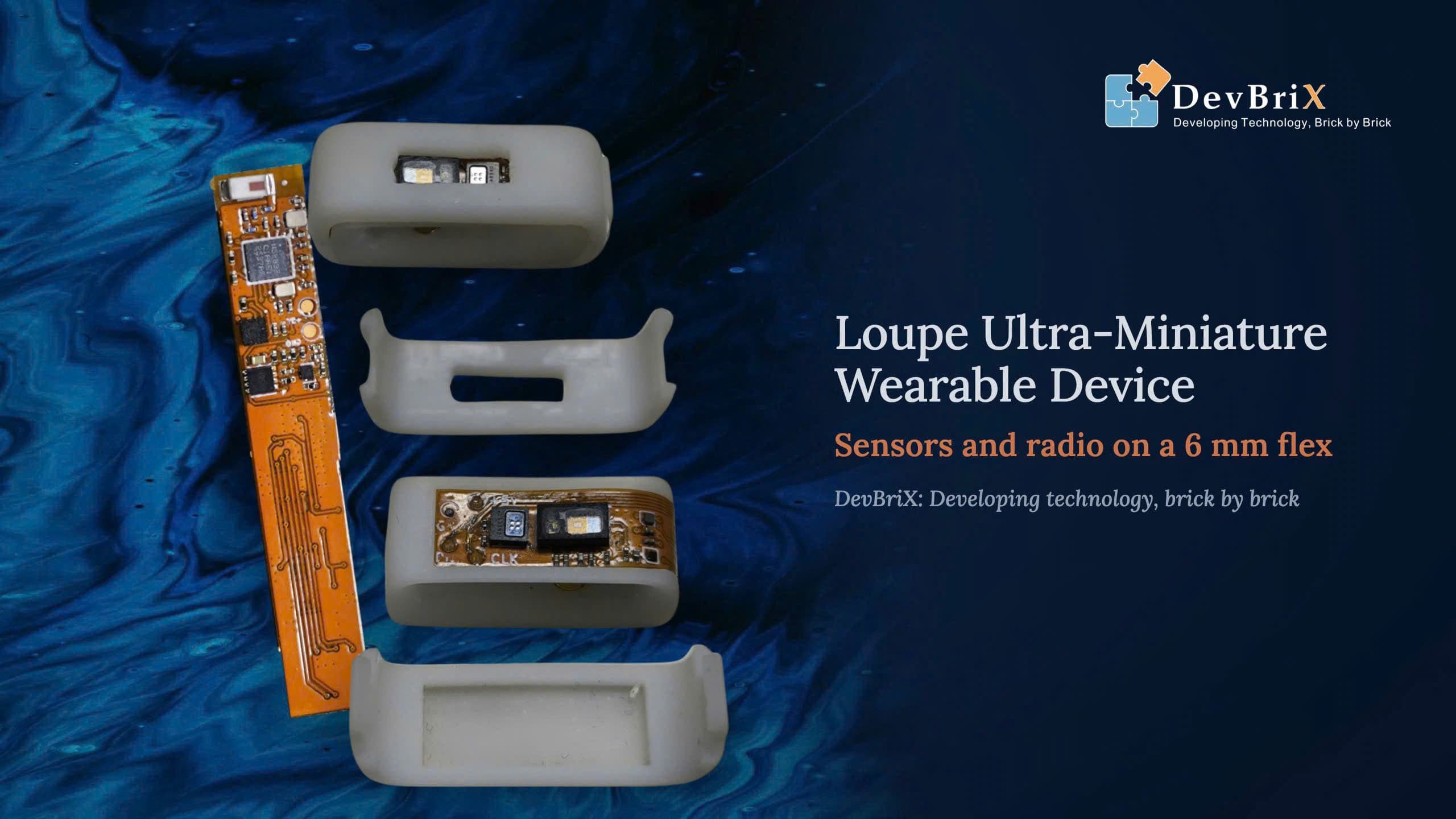
Overview
Loupe demonstrates DevBriX’s capability to engineer reliable, sensor-accurate wearables under severe size and energy constraints, combining biosensors, low-power firmware, and a compact enclosure prototype.
Highlights
- Ultra-compact wearable form factor
- Heart-rate and body-temperature sensing
- Motion-based wake-up
- Magnetic pogo-pin charging
Challenges
- Extreme PCB miniaturization with limited routing and placement flexibility.
- Maintaining heart-rate and body-temperature sensor accuracy in tight space.
- Meeting aggressive power-saving targets with a tiny Li-Po battery.
- Protecting the assembly for moisture and durability.
Solutions
- Used Nordic nRF52832 for low power, compact footprint, and native BLE support.
- Integrated MAXM86161 optical heart-rate sensing with Green, Red, IR LEDs and photodiode.
- Built on a 2-layer flex PCB with epoxy conformal coating.
- Developed C/C++ Zephyr RTOS firmware with event-driven interrupts and deep sleep.
Features
- BLE mobile data transfer
- Accelerometer event wake-up
- Infrared body-temperature monitoring
- ABS/resin prototype housing
- Ultra-small 3.7V Li-Po battery
Key Results
- Validated feasibility of a sensor-rich wearable at miniature scale.
- Completed MVP development in about four weeks.
- Maintained power-saving goals while integrating multiple physiological sensors.
Loupe demonstrates DevBriX’s capability to engineer reliable, sensor-accurate wearables under severe size and energy constraints, combining biosensors, low-power firmware, and a compact enclosure prototype.
Used Nordic nRF52832 for low power, compact footprint, and native BLE support.
Integrated MAXM86161 optical heart-rate sensing with Green, Red, IR LEDs and photodiode.
Validated feasibility of a sensor-rich wearable at miniature scale.