
Custom BLDC Motor Controller
Designed and built a custom BLDC motor speed controller from power board and MOSFET driver to PID firmware, touchscreen UI, and calibrated validation.
Overview
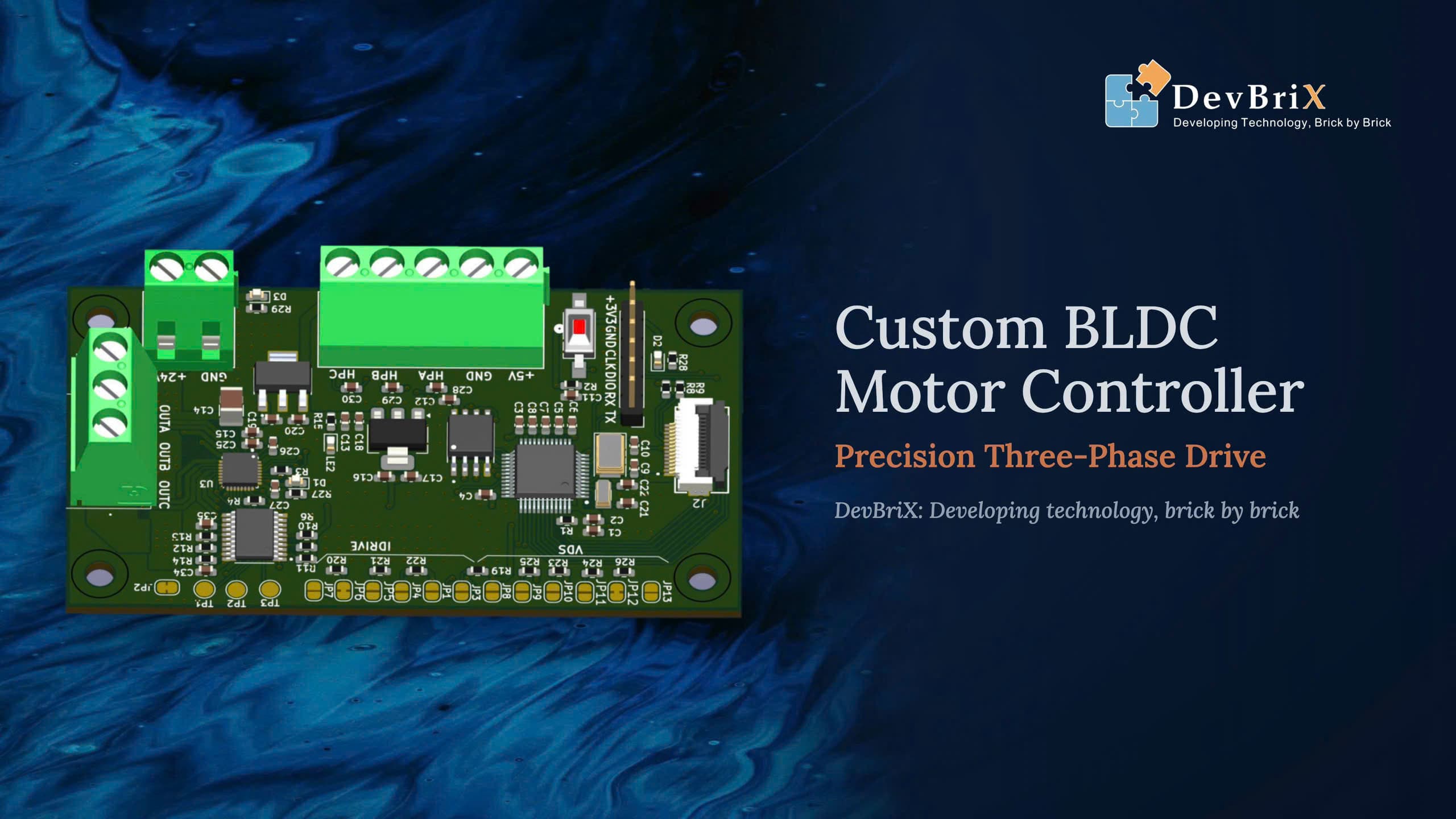
This project delivered an end-to-end BLDC motor controller combining a 2-layer control PCB, STM32G473 motor-control MCU, 3-phase MOSFET bridge, QSPI flash, touchscreen interface, and FreeRTOS-based firmware.
Highlights
- Closed-loop PID speed control
- Touchscreen and physical-button interface
- Hardware-level brake, STOP, and over-speed safety
- Validated against a laser tachometer reference
Challenges
- Stabilize PID speed control against noisy frequency feedback.
- Synchronize motor, display, and button tasks without race conditions.
- Design a clean 3-phase MOSFET driver with gate-drive, switching-noise, and isolation considerations.
- Boot firmware from external QSPI flash using a custom External Loader.
Solutions
- Integrated MCU, driver, power, display, and inputs on one compact 2-layer PCB.
- Separated motor, screen, and button workflows with FreeRTOS tasks protected by mutexes and semaphores.
- Used TIM2 input capture, low-pass speed estimation, bounded PID output, and anti-windup control.
- Cross-checked commanded RPM, on-screen RPM, and non-contact laser tachometer measurements.
Features
- Manual hold, auto ramp with countdown, recalibration, STOP, and over-speed brake modes.
- ST7796 LCD with FT6336 capacitive touch.
- 24V/12V power input with integrated motor-control electronics.
Key Results
- Working prototype built and tested on real hardware.
- Closed-loop accuracy validated against calibrated reference measurements.
- Hardware, driver electronics, and firmware delivered under one roof.
This project delivered an end-to-end BLDC motor controller combining a 2-layer control PCB, STM32G473 motor-control MCU, 3-phase MOSFET bridge, QSPI flash, touchscreen interface, and FreeRTOS-based firmware.
Integrated MCU, driver, power, display, and inputs on one compact 2-layer PCB.
Separated motor, screen, and button workflows with FreeRTOS tasks protected by mutexes and semaphores.
Working prototype built and tested on real hardware.